Taiwan Summary

First, the numbers. I flew out March 3, and returned (after a 36-hour day!) on March 26, for 22 nights. I spent 4 days not cycling (3 in Taipei, and 1 in Hualien). I had an additional 2 days that were short: around Sun Moon Lake, and around Liuqui Island.

While my cycle computer died as I entered the outskirts of Taipei the last day of the trip, an solid estimate is 1,259 km for the trip, averaging 56 km/day (78 km/ day for the days that I rode all day). My longest day was 104 km. I had planned a fair amount of extra time in this trip with concerns about weather and my ailing knee. I rode shorter distances than usual, but still didn’t have a lot of downtime. I still tend to plan on an average 60 km / day. A more relaxing trip is closer to an average of 50 km / day (or get my daily cycling distances back up to 100+ km / day).

Expenses

My total expense for the trip (not counting airfare) was $1,028.48 for 22 nights, or $46.75/day. That’s more than I expected, higher primarily by a couple of AirBnb’s (which were 2-3 times more than the hostels). The only other “big” expense was (not) watching whales, at $30.

The taxis to and from the airport were about $55 (offset by staying with John and Heidi!). The metro fees were negligible. The ferry was only about $15. The train? $4.

Accommodation

I stayed in three BnB-like places, the rest were hostels (not counting the five nights with my friends John and Heidi in Taipei). That’s wildly different than usual, primarily because I never camped.

I primarily used booking.com to find accommodation. I used hostelworld.com once, and AirBnB twice (and then only the first couple of days). Booking.com was the clear leader; I could generally find inexpensive hostels in the $16-$18 range. My average cost per night was $21.51.

Food

I usually carry about a day-and-a-half’s food when touring, and prepare many (especially evening) my meals myself. Not in Taiwan. Prepared food is plentiful and cheap. Small shops open in the morning to sell breakfast. Between the night markets and small take-away like restaurants, finding food is a matter of just stopping where you are for food. These restaurants often have a printed menu where you can mark what you want to order. While in Chinese, Google Translate is your friend. Additionally, many have a similar menu with English they hand to wandering tourists. If you’re food-adventuresome, you have options such as dried duck head, pig blood cake, and fish intestine soup. I never did try the stinky tofu.

And then there’s 7-Eleven. There’s a 7-Eleven on almost every street corner in cities (some times more than one!), and even the smaller towns have several. When there’s not a 7-Eleven there are also Family Mart and Hi-Life convenience stores, but 7-Eleven predominates. In addition to what you’d expect to find in a convenience store, they also serve “prepared” food. For example, many of the 7-Elevens sell small pre-cooked sweet potatoes which serve as a staple for cycle tourists (Heidi pointed this out to me). They also sell fresh prepackaged meals you can heat up in their microwaves (with a number stamped on the packaging for how long to microwave).

It took me a few days to adjust, but eventually I carried less food and water, as I could always stop somewhere and grab food.

Transport

As always, there was a ferry (out to Liuqui Island and back), and a couple of taxis (to and from the airport). I had only one train ride, bypassing the worst 50 km of the Suhua Highway (one of Taiwan’s most dangerous but also most scenic drives). I did spend a fair amount of time in Taipei using the Metro, and one bus ride. A shuttle picked me up and dropped me off from the (not) whale watching.

Gear

I didn’t lose any gear this trip! On the other hand, I had a lot of gear I didn’t need. Taiwan is small, distances between things were short, hostels were plentiful and inexpensive. I should have left the tent, sleeping bag, air mattress, and cooking gear behind. In fact, I _almost_ left it all at John’s, and only kept it as a safety net. I also have space in my panniers for food, but 7/11 was everywhere, so after a while just didn’t bother carrying much food (or water) with me, as I could always stop, also decreasing my overall need for space. Taiwan is ideal for a bikepacking setup.

Before cycling the Suhua Highway, I went back through my gear to drop what weight I could, and left the tuna, pasta, and a half-bar of soap at the hostel.

I needed more sunscreen. While 3-4 oz of sunscreen normally lasts me 4-5 weeks, I “burned” through that much in the roughly 2 weeks of cycling.

Health

I wore a mask on the flights over and back. At a rough estimate 40% of the Taiwanese population wears a mask when out in public, even in cars or riding a scooter. I picked up a saddle sore early on, but that stayed mostly under control with Mupirocin (an antibiotic I carry for this purpose). I did pick up motion sickness meds for the whale watching (twice, as the first purchase was medication intended to be prescription for Meniere’s disease, and I just wanted typical motion sickness meds).

I had a tooth bothering me, and my knee. Ibuprofen kept both under control. I learned that that if I kept my left foot canted slightly inwards my knee didn’t bother me nearly as much. I suspect I should switch to clipless so the clip can hold my foot at that angle. I regularly thought, “My knee hurts; oh I just need to turn it again”.

Other

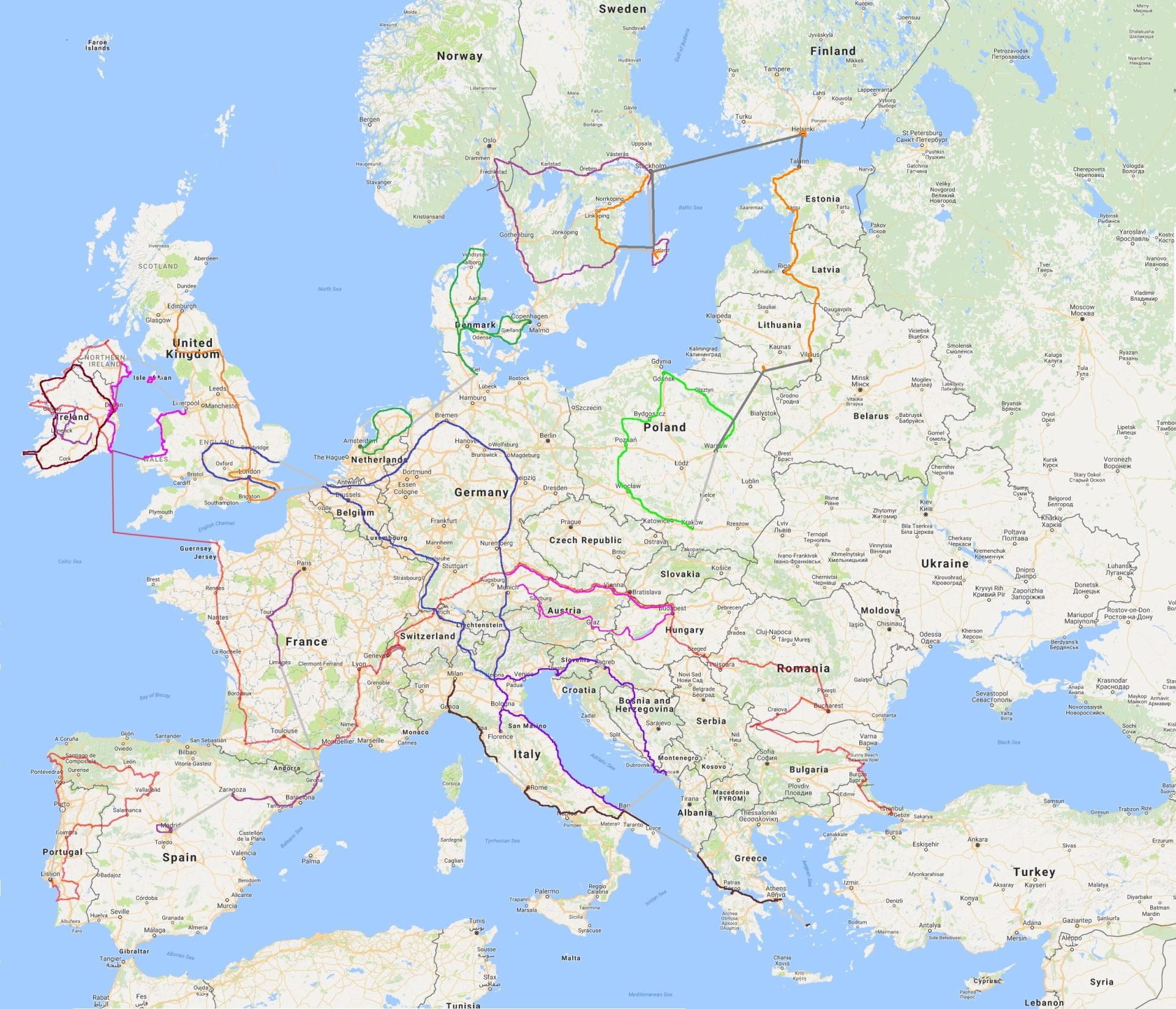
I did something new to create my trip map this time. I used OnTheGoMap, exported the track there to GPX, and then imported the GPX track to Google Maps.

I’ve got the Highlights Photos and the Full photo gallery posted.

Highlights

A few things made this trip particularly memorable. I spent a lot of time visiting with John and Heidi, and it was great catching up with John and getting to know Heidi. My encounter with the effervescent police chief at Sun Moon Lake was heartwarming. I didn’t stop at another police station, in part because of how long it takes and, I think, because I didn’t want to lose that feeling of how friendly they had been on the off-chance the next on wasn’t the same.

Then there’s Alex. I bumped into him early on, and (with some intent) our paths kept crossing despite the fact that I had no hope of cycling at his pace. I’ve missed that camaraderie with cyclists the last few trips, caused primarily because I just can’t keep up, and having that this trip was heartwarming.

Overall? Taiwan was an interesting adventure. Overall I prefer cycling in Europe. More castles.

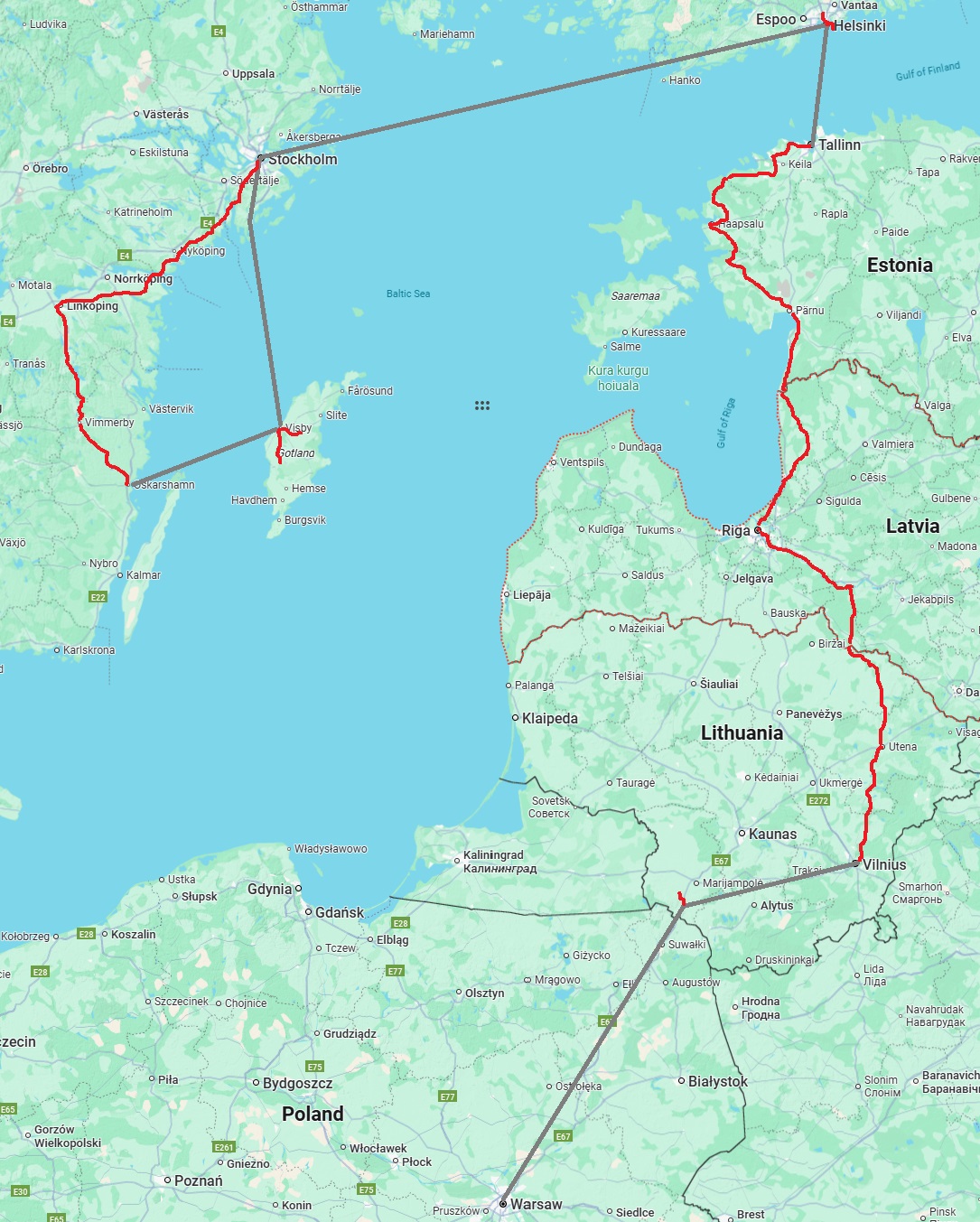
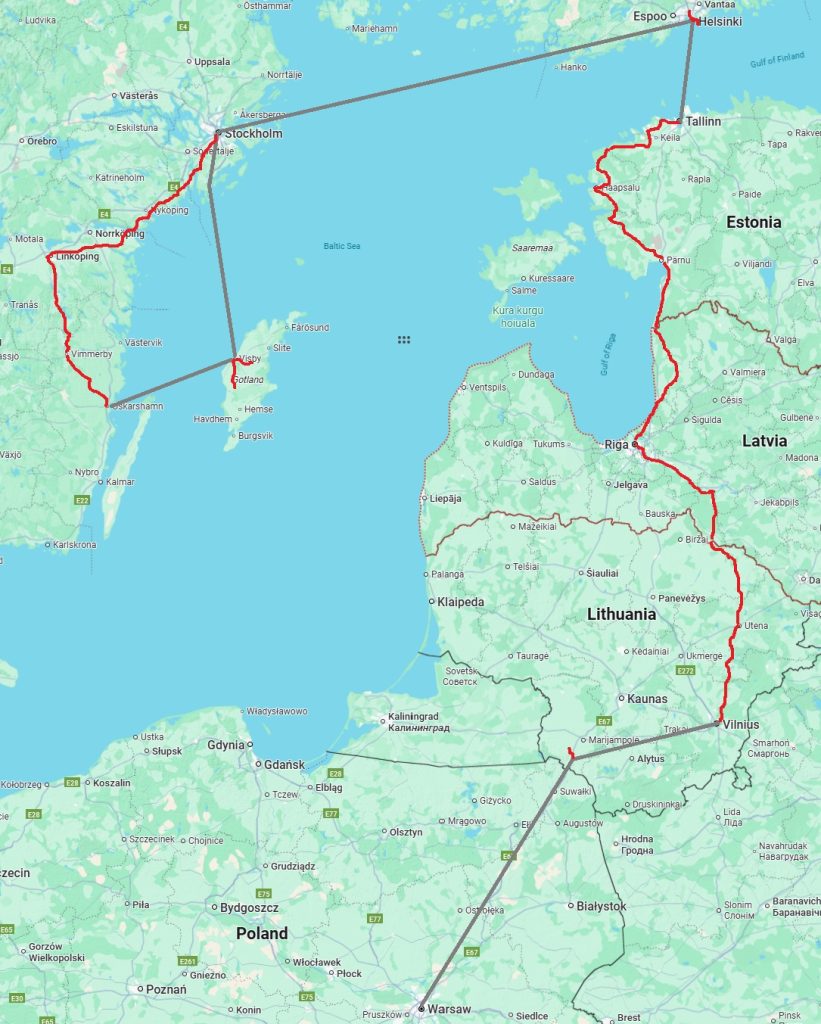
2025 Baltics Summary

First, the numbers. We flew out July 24, and I traveled for 36 nights. My flight home began August 29, and then a missed flight lead to my return on August 30 (and my bicycle August 31!). Linda and I went our separate ways on August 8, her to a farm in Sweden and then Norway, me to a ferry to Helsinki and then Tallinn. I had planned to spend a little more time in Latvia, but I turned south into Lithuania earlier than planned to get at least nominally better roads.

Sweden: 14 nights (with Linda)
Finland: 1 night (but 2 days)
Estonia: 4 nights (but 5 days)
Latvia: 5 nights
Lithuania: 6 nights
Poland (Warsaw): 3 nights
France (Paris): 1 (inadvertently)
(that nights don’t completely line up, as I had two nights on a ferry).

I spent 13 days not cycling (or cycling < 10 km from one place to another), caused in part by our extended stay on Gotland. 1,542 km cycled (561 km for Linda) – an average of 42 km / day total, or 67 km / day for days that I rode. I rode 152 km on my longest day thanks to flat terrain, a but of a tailwind, and poor choices on my part, a distance that put the day in about the top 5 days ever. Days cycling tended to be either ~60 km, or > 100 km. I had planned this trip as an average of 60 km / day, and I need to remember that an average 50 km/day provides a less rushed experience.

I spent 8 nights in hotels, 10 nights in B&Bs, 4 nights camping, and 12 nights in hostels (and 2 nights on ferries) – a far cry from my usual 40% camping / 40% hostels/ 20% other. Part of that derives from Linda not wanting to camp, and part from me occasionally ducking nightly rain by staying not in a tent (or failing to find a campground where I wanted one).

A number of the hostels didn’t really meet my definition of “hostel”. At the core, a hostel is shared accommodation, which they theoretically met except I’d be in a room (or even an entire hostel) by myself, and I really do enjoy staying in shared space with other travelers. However, many of them didn’t have a shared common area or a shared kitchen. The default hostel also typically includes a Front Desk for information, not just a passcode for the lock. The big hostels typically include laundry services. The nicest hostels definitely include Riga (which included an option to camp), and Vilnius (the only hostel I’ve stayed in above a McDonald’s!).

My overall expenses (not counting core travel of flights and the ferry to Finland) were $3,177 for 36 nights. $88 / night (my average / night when travelling alone was only $60). Even so, that is, for me, extraordinarily high. I can attribute that to several factors.

First, of course is the Sweden portion traveling with Linda. We also got tagged by illness causing an additional night’s stay in the most expensive places we stayed ($184),  requiring us to also throw away a reservation one night ahead. I managed to not catch that illness from her, but caught something a day out or Vilnius which just left me feeling run-down for the rest of the trip (more than run down actually, as the medication left me a little disoriented).

I also spent far fewer nights camping than usual, causing both an obvious increase in accommodation cost, as well as  an indirect increase in food cost. I wasn’t cooking for myself from a hotel (and generally wasn’t cooking for myself in the AirB&Bs or hostels either). While I expected the Baltics (Estonia, Latvia, and Lithuania) to be less expensive, they weren’t that much less expensive. They’ve also clearly identified tourism as a source of revenue; even churches charged ~ $10 for a visit (which in turn caused me to not visit a lot of them). I spent over $60 in one day visiting various things in Tallinn. Abandoned castles in fields are much cheaper!

Gear

We didn’t lose any gear at all, which might be a first for me. Airport security confiscated a tube of sun screen on the way home.

I had worried whether I carried a large enough USB battery, but 10,000 mAh worked out fine. Staying mainly in hotels/B&Bs certainly made recharging easier. The zipper on my tent was failing, although I learned where the weak point was and worked around it. This was the (used) replacement tent for my previous Mountain Hardwear SMUL; I hadn’t noticed the failing zipper when I checked its condition. The new rain jacket performed admirably, although fortunately I didn’t have a lot of opportunity to test it. I need to purchase the hood designed to work with it instead of the one from my old rain jacket. I had wider tires on my bicycle than usual (700×35 in front, 700×37 in back); not good enough for the Baltics, but glad I had them. The bicycle computer freaked out twice, suddenly deciding I was riding 105 kph; not really an issue but made me have to do more math at the end. I had forgotten the last time I’d replaced my rear cassette I’d used a 32-tooth instead of a 36-tooth. Most of the route was flat, but there were a few days I would have been happier with more climbing range, especially those times Linda was zooming up a hill.

Linda considers renting the e-bike a complete success. It gave her the ability to keep up (too much the first couple of days as we worked out how to manage her speed). Linda commented it was probably good that we were going our separate ways at the end of two weeks. By the end of our time in Sweden, my metabolism was ramping up; for Linda to keep up she was using 3-4 bars on her e-bike instead of 2 bars. She never ran out of power, and in fact always had a good margin left. Even the 110 km day she ended with 2 of the 5 bars for power.

Health

At one point in time or another both Linda and I were sick (although not at the same time). Linda was better after a day of rest. Even a week after I got home I still have the remnants of the cough. On the bright side the cold medicine did a great job of controlling my cough.

But my knee was the real problem. Even before the trip my knee has been doing something new – it sometimes catches, which is both painful and makes me unstable. I must be able to tell it’s coming, as I usually wonder about my knee about 10 seconds before it catches. At the VERY last minute before the trip I managed to get a cortisone injection, which I don’t know if it helped or not.

My knee is normally just fine for cycling as long as I don’t push too hard. However, with the road quality I spent a lot of time using leg and arm strength to control the bicycle as it slid around, which put torque on my knee. By the time I arrived in Vilnius my knee hurt all the time. Even before then I knew it needed a break, between road quality and feeling “behind”, I just couldn’t give it one. There were many reasons I didn’t ride from Vilnius to Mockava: the weather forecast, bad roads, no direct route. But primarily the knee just needed a break.

Summary

“So how was your trip?”

The first day with Linda zooming off drove me crazy, but by the end of the second day we’d worked that out, and from there our time in Sweden was lovely. Cycling in the Baltics on the other hand I found … unpleasant. Between roads and traffic I had more than one day I questioned my survival. I think it would have helped if I’d given myself more time. All in all by the time I got to Latvia I felt quite rushed (not to mention being VERY tired of loose gravel).

We had great weather almost the entire trip. Although a few days were in the high 80s, almost all of them had a high in the low 60s and a low in the low 50s – perfect weather for cycling. If I’d been willing to wait at the train station that last cycling day in Mockova the trip could have had zero days of getting wet from the rain.

Where next? I’ve had a friend offer to help set me up for a Taiwan trip early next year. I noticed on my map that there’s a clear line from Berlin (one of the few capitols in Europe I haven’t been to) to Slovakia, and the cycle route for the first part of that is well-developed Eurovelo.

Thanks for joining us on our adventure.

2024 Munich Summary

First, the numbers:
Linda and I traveled from May 1 to June 12, cycling from Munich to Budapest. Linda and I arrived in Budapest May 23 and stayed there a couple nights. Then (as planned) I cycled back to Munich by myself. Linda stayed in Budapest a few more days, catching up with me (via train) for a couple of days before spending much of the rest of her trip in Salzburg. When she tired of Salzburg she spent a few days at an agroturismo (and I spent one night there as we straightened out credit cards). She then headed to a spa & water park outside of Munich to relax while I rode to meet her.

Of the 41 nights of the trip, I spent 29 days, and Linda spent 15 days, cycling (although a few of those days are mostly train, not cycling). I spent 13 days not cycling. I rode 1737.16 km – an average of 42 km /day across the trip, or 59 km / day for days I rode. I rode 119 km on my longest day, with 5 days breaking 100 km.

My usual solo breakout is roughly 40% camping, 40% hostels, and 20% “other”. On this trip I spent 8 nights camping, 9 nights in hostels, and the remainder in apartments/hotels/B&Bs. More apartments/hotels/B&Bs because Linda reached an early end to camping. Five of my nights camping were in the post-Linda stage of the trip, which came a lot closer to the traditional 40/40/20 split.  I/we also spent six nights in or around Munich.

At a simple level (not counting airfare), the trip cost each of us about $70 / day, although it’s a little hard to untangle the expense between Linda and I. Significantly more expense than past trips, primarily due to the difference of travel preferences between Linda and myself.

Except for Linda being somewhat under the weather at the end of the trip, and of course the Great Tick Incident, overall we stayed fairly healthy. Linda did not have the speed and endurance either of us had hoped, something we’ll spend a bit more time (and distance) on before the next one.

Lost Gear

While we didn’t have much gear lost, what we lost was eventful. Linda lost one of her credit cards (twice!) eventually leading to drama, including learning that the PIN on one of my own backup cards also didn’t work. That loss compounded with identity theft (and cancellation) of another of my own credit cards. By the end of the trip we had only one fully-functioning credit card out of five.

NOTE: You need to know the PIN of your credit cards. Some times for purchases, but definitely for cash advances.

Linda abandoned the bottoms of a bathing suit, because they kept trying to abandon her when they were on!

Equipment Notes

This trip was the first for our new Hubba Hubba 2 Bikepack tent. It performed admirably. Once the two of us split paths, I missed my much-lighter Mountain Hardwear SMUL2. That said, testing before the trip showed the SMUL2 wasn’t fulfilling a tent’s core mission of keeping water out of the tent; I purchased a replacement for the next time I need it.

Linda and I had put a lot of effort into gearing up Linda’s bicycle prior to the trip, purchasing a special rear rack, special mounts on her Lefty fork, and building a custom mount for her handlebar bag(s). I’d spent time tinkering with her shifting before we left, but (inadvertently) knocking the gravel out of the front derailleur mid-trip made the most difference. I still want to increase the size of her rear cassette to improve her bicycle’s ability to climb. I had only one mechanical problem—a flat tire.

I should have paid closer attention to Linda’s problems with bike fit before the trip. Even a last-minute professional fitting had NOT made things better—she struggled with hand pain and numbness the entire trip. Replacing her medal pedals along the way with plastic ones did mean she spent a lot less time banging up her shins.

We’d also split up the gear so that she had a large set of panniers in the back (since she didn’t have front ones). We should have put my smaller rear panniers on her bike, and I should have taken the larger ones, to just put more weight on my bicycle.

We never experienced power issues. I had brought a 10,000 Ah battery (and Linda a 20,000 Ah one), but we mostly stayed in hotels and B&Bs.

While this only partially falls under “equipment”, one factor we hadn’t considered before the trip was the availability of bathrooms. The most challenging day Linda had was prompted by switching to the other side of the river in the quest for a bathroom, ending up on the mountainous side with a nice, flat trail visible on the other side of the river.

Summary

“So how was your trip?”

Always a hard question to answer. Cycle touring has extreme highs, and correspondingly extreme lows. Linda struggled more than I’d hoped, which didn’t always makes things great for both of us. She’s a real trooper, and it took me a while to figure out just how far past her limits she’d push herself so that I could help manage things. That said, we had only one day where she melted down from exhaustion.  Most days we covered the ground we planned, and adapted with ferries and trains along the way.

With the credit card issues, some train days, and the extended stay in Erding (at the water park) and Munich, I had a lot fewer days cycling than I expected. I’m historically a solo cyclist; having someone along for more than half of the trip cut my solo cycling window short, so the trip certainly didn’t feel like as long as usual. I did however get to stretch my legs a fair amount between Budapest and Munich; while Linda and I weren’t going as far as I’d usually go each day, the distances were enough to bump up my metabolism for later in the trip.

I accomplished my main goal for the trip—I wasn’t single at the end! Things worked out well enough that, after the trip, instead of never wanting to see me again, Linda moved in with me. After the trip she was already talking about the next trip, and we’re currently in the process of figuring out where that will be.

And where next? We’ve talked about a few places, but the current thoughts are cycling together for a combination of Sweden and Denmark, and then me cutting across Latvia/Lithuania/Estonia, where I’ve wanted to go for a while, if only to fill out a part of my map of Europe that’s fairly empty. I had someone tell me that they thought Lithuania wouldn’t be ready to cycle tour in for another 10 years, and that was about 10 years ago.

Thanks for following along on my (and now our!) adventures.

Not a perfect map of the route, but close enough

2021 East Coast Summary

The Numbers

I traveled from June 2 to June 24, cycling from Albany, NY to Durham, NC. I arrived in Albany on June 2 and arrived home on June 24; 22 days of riding (not counting the short ride upon arrival from Albany to Waterford, which then makes the days and nights line up).

I had a couple of short days, but spent only one day not cycling, for 2175 km—an average of 99 km /day total, or a whopping 104 km / day for days I rode. I rode a shocking 164 km on my longest day (and 158 km the day before). That’s significantly higher than previous trips. Starting on the canal paths meant easy cycling, which in turn meant longer days while my conditioning improved. The gravel canal paths were slow, both in base speed, and amount of energy to move. That paid off once I headed south from DC.

I spent 12 nights camping, 7 nights in hotels/B&Bs, and three “Other” (Warm Showers & Nia’s). That works out to be 55% camping, above my usual 40/40/20 camping/hostel/other split. More camping because along the canal paths there are many opportunities to camp. Few hostels, so hotel and camping were the primary options.

At a simple level (not counting bus fare), I spent $980, or $45 / day, right in my usual range, and even then only partially driven by hotel stays (and some camping that cost as much as a hotel!). Accommodation averaged $21 /night, but the mode for hotel stays is more like $65.

I also ate out far more than usual, averaging once/day at $11/day. Groceries were $9 / day.

I spent little on maintenance (< $10) and shipping ($15), and my only Entertainment expense was Niagara.

Lost Gear

My lost gear list tends to be long, but in this case I lost only one thing-a pair of black shorts. I left them in the changing area at Dravo’s Landing, in the “excitement” of everything being soaking wet.

Equipment Notes

After years of people talking about the marvels of the Brooks B-17 saddle, I purchased one in February, and spend the next few months breaking it in (with an average break-in time of 500 km!). I had 500 km on it when I left, and while the fit had improved, I still hadn’t decided if the fit was quite right. Well, after an additional 2100 km, I wouldn’t swear by it yet, but the fit continues to improve. I’ll have to ride for a while on my old saddle now to compare.

I  threw out one of my pairs of bicycle shorts I had with me, as they chafed in a very uncomfortable spot! Two of my pairs of Smartwool cycling socks wore out this trip; I had to wear them so the hole wasn’t at my big toe!  The Exped waterproof bag I store my down sleeping bag in wasn’t [waterproof]. The bag got only slightly damp on that day of Dravo’s Campsite when rain hammered me. My bicycle chain also reached the 50% wear point, so I replaced it when I returned home.

In an unusual reversal, I also added some gear along the way. A spirit level (found just at the right time), and the sandals from the Niagara Falls expedition that are provided with the ticket. I eventually shipped those home.

A bicycle fitting back in January recommended changing my bicycle’s headset and seat position. However, I’ve hated it. The night before the trip I realized that, and swapped it back. Because I had changed out my headset just before the trip, I brought the old headset along with me just in case that turned out to be a horrible decision. When the time came to ship things, the old headset joined everything else on a easy journey home.

That headset change caused other problems however. When I swapped the headset, I’d had to extend my shifter cable. That cable housing worked its way into the shifter, causing me to (mostly) lose the three hardest gears in the back. That didn’t bother me as long as the trails were reasonably flat, but  once I headed south from Erie shifting became awkward. Fortunately a stop at an REI within a couple of days got things squared away, and I experienced no further difficulties.

The tolerance on my fenders is “tolerable”, at least, until I encountered all the mud on the C&O south of Cumberland. Stopping and clearing the mud could have been a major pain, but it happened only once.

I had no flat tires. I did stop at the bicycle shop in Cumberland to add some air to the tires.

After Croatia and Bosnia/Herzegovina’s steep climbs, I came home to replace my smallest front chain ring with a much smaller chain ring. That decision was brilliant; having that improved ability to climb I still revel in.

After stressing the last time on the C&O about power, I brought along a 20,000 mA battery. That certainly solved my problems, but the battery is heavy. 10,000 mA would have easily covered my needs, and weighed less!

Food

A bit of a diet change for this trip. A nutritionist recommended I switch my overall life diet around a bit, with a higher concentration of fats and protein. So significantly more nuts and meat in addition to my high carb diet. I’m not convinced it was better, but I at least don’t think it was worse. Each day, I mostly consumed:

  • 2 bowls of cereal
  • A half gallon of orange juice
  • 200 g of meat w/ 3 bagels (across the course of the day). This could also include pasta with tuna for dinner. Angel hair pasta cooks faster, and thus uses less fuel.
  • 100 g of nuts
  • 1 nut bar
  • 3 bananas
  • A “box” of cookies (most often ginger snaps)
  • A box of something else (often 4 pop-tarts once I found them)
  • Some fast food meal high in calories
  • A sport drink
  • Water. Lots of water. High temps meant 80 oz of water in addition to the above.

Waffle House provided particularly well-rounded but dense calories. Better that McDonald’s!

Summary

“So how was your trip?”

Always a hard question to answer.  After talking with Mark I’ve realized I have two different time windows. The first is after the initial 5 days or so, waiting for my metabolism to flip into overdrive. But I think Mark had a point. At about the three-week window I had saddle sores under control, callouses on my hands and feet, and in general felt better day-to-day.

Niagara Falls (all three!) were interesting, and my only entertainment expense, because there’s just not that much to see along the canal paths.

I followed: The Erie Canalway, the Great Allegheny Passage, the C&O Towpath (and associated WMRT), and the East Coast Greenway, as well as various sections of finding my own way. The GAP was by far my favorite, although it didn’t last long.

My dislike of the poor trail quality of the first 100 km of the C&O is offset by the heavy traffic from the ECG, so I don’t know which of the two I dislike most, but it’s a tossup, even after you add in the (brief) awesomeness of the WMRT. The Erie Canalway ends up on the fairly positive side. If you like quiet nature that elevates it further.

2019 Italy/Greece Summary

First, the numbers:
I traveled from May 7 to June 12, cycling from Milan to Athens. I arrived on May 8 and flew out on June 12; 35 days of touring. Rob left May 20, 13 days in. I caught the ferry to Greece on May 29.

Italy: 21 nights
Greece: 14 nights

I spent eleven days not cycling, for 1874 km – an average of 54 km /day total, or 78 km / day for days I rode. That’s a significantly higher amount of down time, even considering the three nights related to Rob traveling with me. I rode 127 km on my longest day, with no other days breaking 100 km, in part due to accommodation consistently being either 80 km, or 130 km.

I spent 8 nights camping, 15 nights in hostels, and 12 nights in hotels/B&Bs. That works out to be only 23% of my nights camping, far below my usual 40/40/20 split. More hotels/B&Bs simply because of fewer opportunities to camp or hostel, combining that with fewer camping opportunities in southern Italy. I spent a fair amount of time sick this trip, causing me to avoid camping. I also spent a record five nights in Athens.

At a simple level (not counting airfare or ), I spent $1768, or $50 / day. A ~10% increase over previous trips, driven by: increased strength of the euro, with me not feeling well as an associated factor. I visited fewer attractions than usual, so that cost is even more driven by accommodation (and ferries, which added $144 to the total).

I spent more time ill this trip, and more ill. The cold near Altamura is just par for the course. I spend enough time on the road that occasionally being sick is no different than home.  The appendicitis-like episode on the other hand was different. That took me out for days, and I still don’t know quite what it was. Still, besides the emotions of, “what’s going on?”, the combined total of both episodes was only a few days.

Instead of cycling down from northern Albania, I cut my initially-planned trip short by taking the ferry directly to Greece, due to (mostly unfounded) concerns about mountains in Albania. I realized after returning home I made that decision while both sick and under the influence of cold medication. That choice eventually lead to me arriving in Athens far too early.

Lost Gear

A number of things managed to make their escape, primarily in the first few days before I had my rhythm. After years of trying, Soap Dish made it out before I’d even left Milan. The stuff sack for my warm jacket fell out of my pocket somewhere in northern Italy during those early cooler days in the mountains. After the rain crossing into Genoa, I put the rain covers for the panniers somewhere to dry in the hostel; out of sight, out of mind for gear that’s relatively new to me means an easy escape.

Equipment Notes

My watch failed Day 1. Not having the date and time immediately available did weird things to my ability to track time and day. I kept thinking about finding a battery, but that watch is programmed with a cable that I didn’t have. That loss of time sense is another contribution to shortening my trip by bypassing Albania.

I’d made a number of changes and repairs to my bicycle before leaving. I’d changed out the headset to make the bicycle geometry more closely match my alternate bicycle. I failed to consider the change in cable length that caused, leading to a source of irritation of hard turns making the rear brakes rub.

I’d replaced the fender I tore up somewhere in Croatia or Bosnia, the new fender having narrow clearance between the fender and tire. I’d intentionally not replaced the tire, but margins were razor-thin. Enough that sand on the tire would scrape the fender. After repeated tinkering I figured out how to move that from “irritating” to “tolerable.”

I had only a single flat tire (as did Rob) which I can’t complain about. Realized that first tube had two patches, I purchased a completely unnecessary spare in Pisa. Repairing Rob’s flat led to the discovery that his bicycle shop had for some reason last replaced his tube with one meant for much smaller tires – weird.

The worst failure was the damage to Rob’s rear derailleur hanger. Whether the flight banged it up, or Rob had damaged it when he’d fallen a couple of weeks prior to the trip, we were fortunate that Rob immediately noticed the derailleur pinging on the rear spokes. If that derailleur had been off by even one more millimeter it would have gone into the spokes and likely destroyed itself and the rear wheel. Careful tuning addressed that, although concern for that failure stressed both Rob and myself for the remainder of his trip.

On a related not-quite-failed gear note, Rob’s rear cassette has a “mega” gear – the largest gear as a substantial jump up from the preceding gears on the rear cassette. I used to think those were a great idea, but my opinion has … shifted. While that gear brought Rob’s overall gear range closer to to my own, it meant he had no ability to vary in the upper range. I could shift up and down to vary the work for minor variations in steep terrain; Rob could not. Those gears might be great for short, quick bursts, but not extended climbing.

After Croatia and Bosnia/Herzegovina’s steep climbs, I came home to replace my smallest front chain ring with a much smaller chain ring. That decision was brilliant; having that improved ability to climb I repeatedly reveled in, even at one point climbing an extended 14% grade.

I still stress a lot about running out of battery power with my 5,000 mA battery. While I had to talk Rob down from carrying ~40,000 mA of power, I stress about running out of power when low, even with carrying a second phone. I keep thinking about carrying more battery, but really there’s no point to it; I never came close to running the phone and battery out of power. My only real mistake at one point was wandering about somewhere with low power when I’d left the battery behind.

Summary

“So how was your trip?”

Always a hard question to answer. Cycle touring has extreme highs, and correspondingly extreme lows. This trip probably had more lows than highs. I didn’t end up with any particularly quirky stories (both a plus and a minus).

With my scheduling snafu and illness near the end, I “lost” about a week of cycling. I’m primarily a solo cyclist; having someone along for effectively half of the trip cut my solo cycling window short. Rob commented at one point that the trip was the most time he’d had alone in years. Inversely, for me it was the least time I’ve had alone in a long time. These factors lead to the trip feeling only a couple of weeks long.

It really wasn’t until Greece that I found my groove. Cycling along the coast of Greece was incredible. I’d been concerned about the mountains of Greece, but the long steady grades were more than manageable (as long as I paid close attention to routing). I encountered far more hostile dogs in Greece than anywhere else I’ve ever cycled. The roads (and drivers) were fantastic (good, because I could stay on larger roads decreasing dog encounters).


And where next? Thoughts include the C&O trail in the US, and Puerto Rico, both a bit closer to home. They’d also let me answer “yes” to everyone who asks if I’ve cycled in the US. Lithuania and the southern coast of Spain are the only real stretches left in Europe I haven’t cycled through, so I’ll need to move farther afield soon.

181125-Weirdly Home

I’ve been home for more than two weeks, but only now am I starting to feel at home. That’s taken longer than usual, and I don’t quite know the cause. Perhaps the jet lag from traveling in the other direction. Or because it was additional cycling trip at a time unexpected. Two intense weeks of Red Cross training-with class from sunup to sundown-preceded the cycling part of the trip. The transition from home, to class, to cycling, to home, didn’t leave adjustment time in between.

Of woes I had the usual with a few new. I would never have selected New Zealand as a cycling destination on my own. The time of the year was wrong. Weather was cold, windy, and intermittently quite rainy. Terrain in New Zealand is rugged, and drivers are not known for their acceptance of cyclists. And, of course, no castles.

The transition to cycling touring is always difficult, and I hadn’t been on a bicycle since June, making the first few days particularly challenging. Renting a bicycle I regretted every day (I’m sorry my bicycle – I won’t leave you behind again!). Even with my backpack/trunk, the lack of a handlebar bag and front panniers limited my cargo space. I had zero flat tires from Istanbul to Ireland. Of this trip’s 9 actual days of cycling I had 5 punctures! I blame the combination of the narrow tires on the rental, and the extra weight on the rear due to the lack of front racks (which I again blame on the rental).

That said, I adapted. Once I actaulized I was in no hurry, I walked up hills instead of persisting in a valiant struggle. I did a good job of ducking rain. The one day I cycled in rain served as a reminder that I have quality rain gear. I moved gear around to increase my cargo space. I repacked the tools and tubes so they were more readily accessible when performing tube repair.

In Rotorua I watched  Kiwis have little regard for pedestrians, and that attitude extends to their respect for cyclists. Unlike other countries, Kiwis expect cyclists to move or otherwise be out of the way. I don’t think it’s all attitude however; tight, twisty roads left cars little choice but to pass close by. Everywhere I met friendly people, who would stop to chat by the side of the road.

When I first studied maps of cycle routes in New Zealand, I noticed that the routes were circular and disjointed. On the other hand, I desired distance! I spent a lot of time routing, and am fairly happy with how I pieced different routes together, with minimal time speak in heavy traffic. Indeed, I spent the vast majority of my time on small roads or dedicated cycle path.

I started cycling on October 23, and flew out on Nov. 7, translating to a ~15-day cycling trip. I spent nine nights in hostels, camping only three nights, staying in a motel for two nights, one night in a wilderness lodge. That’s wildly different than my usual ratio of 40% camping/40% hostels/20% Other, an intentional decision based on the spring weather. Camping in NZ generally cost the same as hosteling anyway!

I estimate the trip at roughly 860 km, or ~57 km / day, right at my usual average when calculated across the entire trip.  Subtracting the bus ride from Taupo to Napier of 140 km, the daily cycling average works out to about 80 km / day. That’s less than usual, but the shorter trip meant I never reached the capability of more extended distances. There was also a lot of walking, which slows me down!

Much like everything else on this hybrid trip, expenses calculate oddly. My travel expenses include only bicycle rental, the gas and insurance from the “free” car rental from Wellington to Auckland, the bus from Taupo to Napier, and the ferry to Somes Island.  The “taxis” to and from the airport, as well as my flight, were covered by the Red Cross as part of my training. Andy picked up part of the cost for the rental car. Transportation worked out to $277 of my $900 total trip cost, making the trip sans travel about $41.50/day, my average touring expenses.

I normally carry a stove and cook much of my own food. I intentionally left my stove behind after factoring in the hassle of finding fuel, the shorter trip, and need to limit my gear (for cargo space). That meant I ate more prepared food, increasing my food expense. In hindsight, NZ is an outdoorsman’s paradise, with multiple outfitting stores in every city of size. I contemplated buying a stove while in Taupo (even wandering through several camping stores), but at that point, half-way though the trip, I just fretted a bit more about food.

I’ve asked myself more than once, “Would I have made the same decision to cycle across NZ again?”, and in all honesty I don’t know.  Not much of the cycling stands out (which isn’t necessarily a bad thing!). Except for the narrow roads into Rotorua (and the bus into Napier) I had good roads or dedicated cycle path. The one thing I’d probably change is making it longer. Longer is better in cycling. More time on the road makes everything easier. Oh, on MY bicycle.

I can definitely say I am glad to be home.

2018 Adriatic Summary

I traveled from May 1 to June 14. I arrived on May 2 and flew out on June 14; 43 days of cycling, and 43 nights.

Italy: 24 nights
Slovenia: 5 nights
Croatia: 4 nights
Bosnia: 7 nights
Montenegro: 3 nights
(San Marino: 1 day)

I spent eight days not cycling. 2630 km – an average of 61 km /day total, or 75 km / day for days I rode. I rode 139 km on my longest day, and while only a couple of other days were ~100+ km, ~10 days were in the 95-99 km range.

I spent 16 nights camping, 21 nights in hostels, 5 nights in hotels/B&Bs and 1 night on a ferry. That works out to be 37% of my nights camping, 49% of my nights in hostels, and 14% of my nights in “other.” Not that far off from my usual 40/40/20 split, with more non-camping in Croatia and Bosnia (land mines!). When stressed I prefer hostels, and hotels/B&Bs simply because of fewer opportunities to camp. Near the end of the trip I sought out campgrounds, both to economize and because I felt better.

At a simple level, I spent $2015, or $46 / day. An increase over my usual average $42, driven almost entirely by increased strength of the euro. I also visited multiple attractions that cost > $20.

I had planned to spend less time in Italy, cycling instead into Albania. However, by the time I reached Montenegro, I was tired of the Balkans. Narrow roads with high traffic. Crawling up steep mountains. Land mines. Tunnels. At that three-week point if someone had offered me an easy way home I would have taken it. I realized I only cycled towards Albania to say I’d been to Albania, and then for so little time it wouldn’t feel like I’d been in Albania anyway! Arriving in Italy, at least one iteration of my plan had been to cycle across the mountains to Rome. Instead I decided I was done with mountains, and cycled up the flat Italian coast with ready camping and beaches, a respite I desperately needed.

I had the worst cycling accident I’ve had in decades (even on tour, once being hit by a car in France did no damage). In the short term I sewed up the pannier and a bicycle shop substituted an alternate shifter. I didn’t do much damage to myself except for my pride, and the bandages weren’t that expensive (although it took a few tries to convey “Band-Aid” to the pharmacy). Longer-term, I’ll have to replace that broken shifter, and likely the panniers, for about $300.

Working back through the photos and blog has been good, reminding me of positive things that were just washed out from my Balkan struggles. I’m not quite certain what’s next, but I’ll come up with something!

2017 Irish Sea Summary

As usual, after I’m home for a few days I like looking back over the trip. This trip, including travel days, worked out to 30 days/29 nights (counting the arrival and departure days):

 Country  Nights
In the Air (8th to 9th)  1
Ireland  2+9
N. Ireland 5
Isle of Man 3
England 2
Wales 8

Expenses

Despite my intent to go to the UK after the hit to their currency from Brexit, both the euro and pound had gained on the US dollar since my last trip. My daily expenses averaged $41, almost identical to Istanbul to Ireland trip of roughly $41. Of particular note:

  • $15.93/day lodging costs
    Low of ~$8, high of ~$31.The two days in Newcastle waiting for bike repair at $31 really upped the overall average
  • $8.46/day in transport costs ($4.14/day Ferry costs)
    Three ferry rides (five, counting the short ferry ride across the N. Ireland border, and the other south from Liverpool), certainly had a financial impact. In particular, the ferry to the Isle of Man doubled in cost during my delay until I was certain I visited Carrickfergus castle before leaving N. Ireland.
  • $1.31/day Cash Advance/Exchange fees
    I pulled cash from an ATM four times (each time I crossed a national border), plus the one failed attempt (which I’m still trying to untangle with the credit card company) just before crossing the border to N. Ireland. Crossing multiple borders in a short time meant more dealing with currency.
  • $2.42/day Bicycle maintenance (headset, oil)
    I always end up buying oil, because I never start with much. The failure of the headset was, I think, the worst mechanical failure I’ve had while touring. Except for a harrowing ride down into Newcastle, no real harm or foul.
  • 5.98/day Entertainment
    Things like postcards, castles, and other attractions.
  • 8.46/day food
    Including restaurants (often McDonald’s or Subway).

Accommodation

I typically average 40% of my nights in campgrounds, 40% of my nights in hostels, and 20% of my nights in “Other”. An abundance of campgrounds, good weather, and a lack of hotels led to a substantial increase in camping. More than a few times I would have picked a hostel were one available given the cold and/or wet. On this trip:

  • 16 nights in campgrounds (averaging $14.74/night), 57%
  • 11 nights in hostels (averaging $23.69/night), 40%
  • 1 night at Kieran’s (Sam’s Dad)

Food

With food calculated in days instead of nights, over the course of the 30-day trip I spent $254 on food (meals, groceries, snacks, drinks, water), or $8.47/day, almost evenly divided between groceries and non-groceries ($4.43 was groceries). That’s substantially less than the $12/day on the Istanbul to Ireland trip. That decrease unfortunately derives in part from my low energy levels. I was just never eating enough. I also purchased a lot more of my food this trip in large supermarkets (decreasing the cost). Unlike the almost daily activity of the Istanbul to Ireland trip, I only purchased groceries every couple of days, in part because I had little fear of not finding a market.

Gear

I have honed my gear list over the years, and don’t make a lot of changes to it. That said, I always tweak things here and there.

My Mountain Hardwear down sleeping bag rides the ragged edge for warm enough for some nights in the British Isles. If I was thinking about it before I went to sleep, I’d throw my jacket over my feet, which made a big difference. But a couple of nights I woke up just enough to know I was cold, and not enough to do anything about it – miserable!

I wear sandals as my alternate footwear from bicycle shoes. They’re lightweight, and dry faster than a pair of tennis shoes. Years ago at the beach Marnie and I purchased cheap beach sandals. When I realized how light mine were, I used them to tour with, and they served me well for many years. When they wore out, I stole Marnie’s sandals and used those. For this tour I needed new sandals. When I was deployed with the Red Cross to the NC coast I picked up a new pair. It took a few days of shaving off sharp bits of plastic to get them to not rub on my feet, but after that they were great. Sadly, they died at the airport when jumping over a wall to get to the car. But if they were going to fail, it couldn’t have been at a better time.

Charging my phone in hostels is typically easy. I carry a two USB adaptor so I can always find a spot even on the most crowded power strip.  The past couple of tours I’ve also taken a 3500 mA USB battery to charge my phone. It serves as a backup in case I mistakenly run down the phone in the field, and I can charge the battery in the campground bathhouse at night instead of leaving my phone there overnight. While I never ran the 3500 mA battery out, I came close a few times. This trip I purchased a slightly larger (and heavier!) battery at 5000 mA. The campgrounds are doing their very best to remove all available power outlets, but with the slightly larger battery, careful battery management, and the extended life of a Droid Maxx, I never had any concerns for power this tour. Ireland uses a different power plug than the rest of Europe, but it’s worth carrying a European adapter because the bathhouses typically have a European outlet for electric shavers. I also found outlets behind the dryers.

There are a few things that are likely to not go on the next tour. While I had a waterproof plastic map case, I rarely used it.  On the flip side of that, I’ve got a waterproof phone case that mounts on the handlebars. I never used it, and it was always in the way. And even with the colder weather, I never really wore the cycle tights (which is good, because they’re at end-of-life anyway. The stitching on one of my panniers is starting to go.

Distances

Distance-wise, my odometer shows just a hair under 1,500 km for this trip. That’s fairly typical for one of my three-week tours, but it’s low for four weeks. I was never happy this tour with how far I cycled every day. The first few days were especially miserable before I adjusted the bicycle seat and/or broke the seat in a bit more, but my old seat is still more comfortable.

I averaged around 70 km, which I attribute to a number of factors. Nights were wet; packing up in the morning was slower than usual. Wales was really hilly; I spent a fair amount of time each day in Wales walking up hills. I also never really felt like my energy levels came up like I expected.

Many days I stopped at multiple sites; spending a lot of time at them certainly slowed me down. A quick check shows I visited a couple of abbeys, a few churches, and 34 castles (as well as a few along the way I never knew the name of).

Back to the mundanities of day-to-day life.

Food

With food calculated in days instead of nights, over the course of the 113-day trip I spent $1,355 on food (meals, groceries, snacks, drinks, water), or $12/day. Over the course of the trip, I went to a market, in one way, shape, or form, 108 times – grocery shopping effectively every day, and sought fuel to cook with three times.

I eat, even when not touring, a really boring diet – a grain cereal breakfast, sandwiches for lunch, and pasta for dinner, eating out occasionally at budget restaurants with the occasional splurge. Touring I eat the same way, with more fruit and calories. Every day I tend to eat one to two packages of cookies/sweets, 3-4 fruits, a liter of fruit juice (along with water), 100-200g of nuts, and (hopefully) about 100g of meat. I work very hard at never being hungry, so I eat small amounts often. Realizing I feel hungry means I’m going to run out of calories before I manage to get enough calories back into my system. For that reason I also tend to carry something as a backup that’s primarily glucose.

Over time I found that I felt like stopping for lunch 30 km from wherever I started, also providing a break from cycling. Ireland and northern France screwed with that routine a fair amount; between the cold, driving winds, and rain, I often wasn’t in a comfortable position to stop at that point. In that case I ate more raw calories and powered on.

I ate at restaurants (defined as me not preparing anything or having dishes to wash) as well. Preparing my own food was more difficult when staying in a big city and when by myself (or with Sam) I regularly ate lunch and dinner at Subway and McDonald’s respectively. I eat at McDonald’s and Subway because: Free Wi-Fi, food I know what’s in it, free Wi-Fi. A majority of the actual restaurant meals were in Bulgaria, Romania, and Hungary, and often food prepared by the hotel, hostel, or campground. The remainder of the time I ate at restaurants primarily when hanging out with fellow travelers.

McDonald’s: 26
Subway: 27
Other restaurants: 48

Accommodation

From the FAQ: Historically accommodation works out to about 40% camping, 40% hostels, and 20% “Other”. That can depends on the country, and how good my maps are.

The tour from Istanbul to Ireland lasted 112 nights (the nights of June 10 to September 29). I spent 43 nights camping (38%), 43 nights in hostels (38%), 12 nights in hotels (11%), and 14 nights in “Other” (13%). “Other” includes: Wild Camping (2), Guest House (1), Pensiune (2), Hospital (1), Friends (4), Cabin (1), Train (1).

Finding accommodation in Eastern Europe proved difficult, with few campgrounds, hostels or hotels unless in a larger city. In Eastern Europe I mostly stayed in small hotels (which cost less than hostels in Western Europe) unless in a larger city with a hostel. I avoid hotels when possible because I rarely meet fellow travelers there. All of the hotels I stayed at met my needs. Those hotels labeled “pensiune” tended to be the most sketchy.

At the most basic, a campground provides a bathhouse. In most cases the bathhouse provides hot water, and often houses the Wi-Fi. On the EuroVelo route, campgrounds were usually a bathhouse and shared open field, with cyclists scattered randomly. Once moving off the EuroVelo route, campgrounds changed to the more formal arrangement of separate defined sites for each camper, and sometimes distinguished between sites with and without power. Often a small on-site café offered a basic meal. In Ireland, land of inclement weather, campgrounds provided a common sheltered area, which often included a basic kitchen. The campgrounds in northern France which cater more to those camping from England and Ireland tend towards that same style.

The number of potential guests differentiates hostel from hotel. While some hostels offer single and double rooms in addition to dormitory accommodation, at the core hostels provide, for better or worse, the shared group sleeping experience that hotels do not. Beyond a bed and bathroom, many hostels offer a shared command area and shared kitchen for communal use, and more often than not they include breakfast in the price. Hostels can be divided into those hostels that are members of the International Youth Hostel Association (IYH), and those that are not.

IYH hostels generally provide breakfast, and tend towards larger and more institutional than the independent hostels. Many years ago, staying in an IYH hostel required a membership, carrying your own bed linens, and in some cases required individual travelers arrive under their own power. Over the years those requirements have relaxed. Only a few of the IYH hostels on this trip required membership, although some provide a discount should you also be a member. Those IYH hostels that require membership sell the memberships for ~ $11. I purchased an IYH membership in Lyon. They kept the membership card as the deposit for the room key, which I didn’t realize until 10 km down the road that I’d failed to return, and chose to abandon it. While I was willing to purchase the membership again, at the few IYH hostels that required membership I convinced them that I’d bought a membership in Lyon and they let me in.

Some paper maps display hostels as well as campgrounds, with less surety of their existence. OSMAnd+ (my GPS application) also listed hostels. Maps and OSMAnd+ worked off-line, helpful during those times I had no Internet access. While not 100%, HostelWorld (www.hostelworld.com) lists many hostels, and I often used the HostelWorld app to find and book hostels. Prices on HostelWorld let me control expenses, and the savings there generally offset my costs for Internet access. HostelWorld also includes a number of hotels. The reviews on HostelWorld vary wildly depending on experience and hostellers nationality, so reviews for cleanliness vary wildly, but the reviews can provide insights such as: “hostel sits directly over a loud bar.”

I originally intended to use CouchSurfing (Couchsurfing.com) and Warm Showers (Warmshowers.com) as alternatives to the more conventional places to stay, but in the end never availed myself of those services. I tried WarmShoweres in Istanbul, but between poor communications and the website not compensating for a poor response rate I didn’t use it again. Between my somehat random travel itinerary, inconsistent Internet access, and preferring to stay with travelers of similar inclinations, I never used CouchSurfing.

• Average/Most/Least expensive camping: $12.71 / $25.38 (Switz.) / $6 (Ireland)
• Average/Most/Least expensive hostel: $20.38 / $36.80 (Switz.) / $11.50 (Romania/Bulgaria)
• Average/Most/Least expensive hotel: $21.80 /$31.61 (Bulgaria) / $10.14 (Turkey)
Note: hotels and hostels don’t compare to each other well at all, since I never stayed in a hotel out of Eastern Europe.